 Skip to content



Floating Dock for Personal Watercrafts: What You Should Know Before Buying
Owning a personal watercraft is all about freedom on the water — but that magic can fade quickly when it’s time to launch it or bring it back to the dock.
These manoeuvres can easily become frustrating… unless you have the right equipment.
At Candock, two systems have proven themselves: the JetRoll and the JetSlide — both designed to keep your watercraft out of the water to reduce premature wear.
Here’s what you need to know to navigate between both options.
JetRoll vs. JetSlide: The Key Differences
Both Candock systems have the same goal: to make launching and docking easier while keeping the craft fully out of the water when not in use.
Each one, however, has its own advantages and distinct characteristics. Let’s break them down.
The JetRoll System

The main feature that sets the JetRoll apart is simple… its twelve urethane wheels.
Positioned along the center of the dock, these rollers can be configured to fit a wide variety of PWC models, always ensuring a smooth, low-friction drive-on and launch.
Another important detail: the JetRoll is monobloc — molded in a single piece of MDPE (medium-density polyethylene) and 100% filled with expanded polystyrene, making it completely unsinkable.
Its compatibility is nearly universal: the JetRoll can be installed on Candock modular floating docks, on fixed docks of any type, on breakwaters, and even on simple Candock posts (in shallow water). It supports up to 2,000 lb.
The JetSlide System

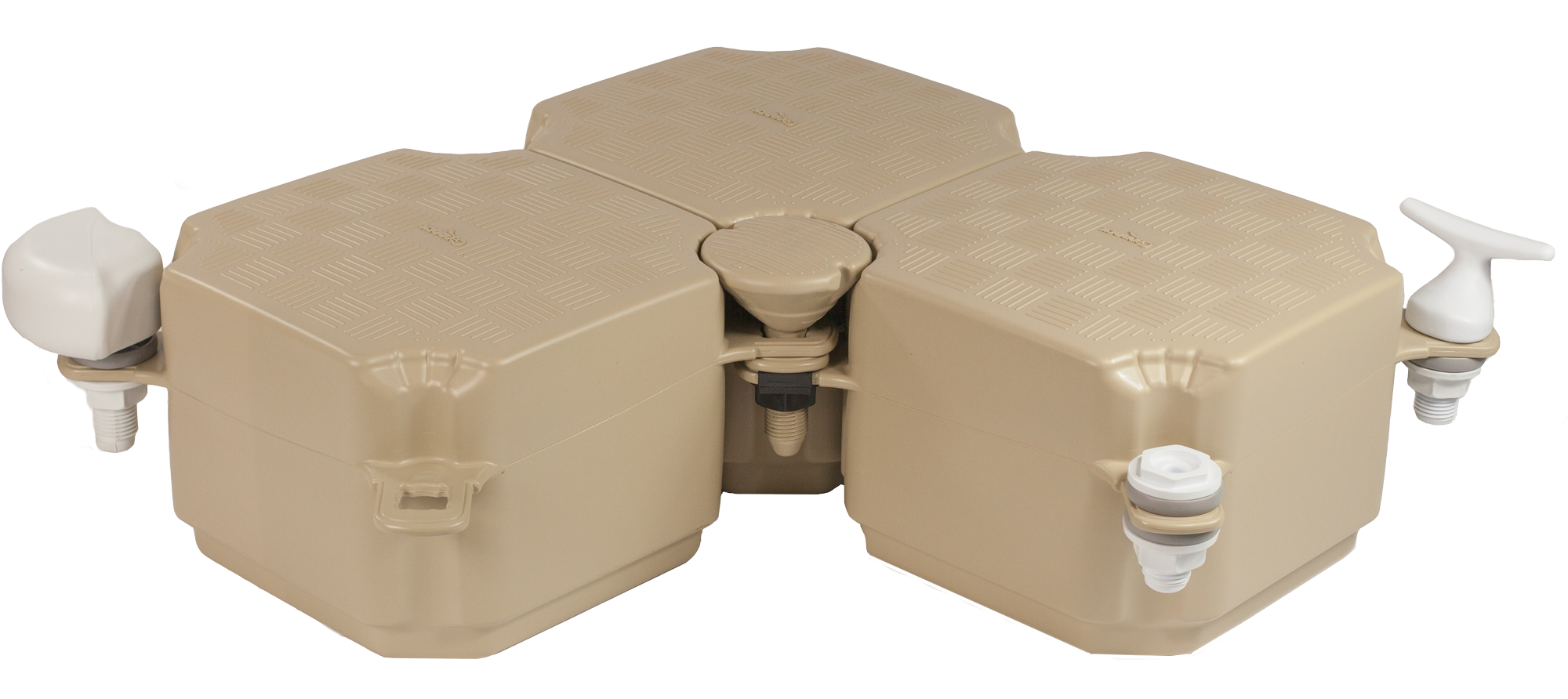
The JetSlide is built from a long central piece of about 10 feet, designed to support the PWC along its entire length. On each side, a row of Candock cubes is added to reinforce buoyancy and stability while ensuring seamless integration with our modular floating docks.
Its low-friction surface allows the PWC to slide and centre itself naturally, without effort and without movable parts. Made from HDPE (high-density polyethylene) and filled with expanded polystyrene, the JetSlide offers strong flotation and excellent resistance to impacts, moisture and temperature variations.
Its maximum capacity is 1,500 lb, suitable for the vast majority of PWC models. The JetSlide performs best in calm waters, where wave height remains under three meters. Versatile by design, it can be used as a standalone installation or attached to virtually any type of dock, while offering an especially natural fit with existing Candock configurations.
How to Choose Between JetRoll and JetSlide?
JetRoll and JetSlide serve the same purpose, but each has its own personality.
Here are a few questions to help clarify your choice.
1. With wheels, or without?
With the JetRoll, the PWC literally rolls along the system, offering a very smooth feeling during both launch and recovery.

With the JetSlide, the PWC slides on a low-friction surface, propelled only by engine power or a light manual push.
Wheels can make manoeuvres even easier. While this can be a deciding factor, other aspects may influence your choice.
2. How much does your watercraft weigh?
The JetRoll supports up to 2,000 lb (craft + rider), making it well-suited for heavier or more equipped PWCs.

The JetSlide, supported by cubes, offers a capacity of about 1,500 lb, which covers the vast majority of PWCs while ensuring stable flotation and even hull support.
3. Stable… or even more stable?
The JetSlide’s side cubes widen the docking platform around the PWC, providing a noticeably more stable area for boarding, securing the craft, or moving around the dock.

The JetRoll, being more compact, creates a centred zone ideal for tighter spaces. Its monobloc structure provides ample stability for most uses, while keeping the overall footprint minimal.
4. Where will your dry dock be installed?
Both systems — JetRoll and JetSlide — are compatible with many types of docks: wood, aluminum, fixed structures or floating docks. They can be used as standalone systems or mounted to any existing dock, offering great flexibility in adapting to your current setup.

The real difference lies in the type of environment.
· The JetSlide performs best in calm water, where conditions are moderate (waves below 3 m).
· The JetRoll adapts easily to a wider range of environments and can handle areas with more variable water movement.
5. How simple do you want things to be long-term?
Both systems are free from structural maintenance: built from MDPE or HDPE, they resist UV rays, corrosion and the harshness of marine environments.
The difference lies in how they behave over time:
- With JetRoll, you benefit from rollers that provide extremely gentle manoeuvres. Over many years of use, some wheels may eventually require adjustment or replacement.
- With JetSlide, you choose a system with zero moving parts, designed for maximum mechanical simplicity: no rollers, no bearings, nothing that can seize or require replacement.
In short…
In conclusion, there’s no wrong choice — it all depends on what you need for your watercraft and your dock.
If you still hesitate between the two systems after reading this, our team will be happy to help you decide. Contact our customer service here.
And if your choice is already clear, you’re ready for the next step!